
Water Cooling : Current Water Cooler
This is a chronicle of my custom-built multi-system passive radiator, system water blocks, and accompanying water distribution system. I continually update this page with the latest developments and additions, so check back often!
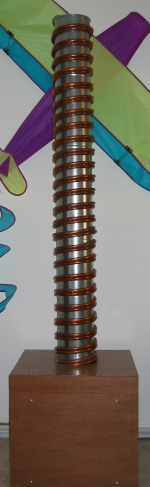
Over the past two years, I have built a central radiator, a number
of heatsinks for components in and out of the computers, and the
accompanying monitoring system to evaluate performance. With the
radiator passively cooled, I achieve water temperatures 9-10C above
ambient, and component temperatures well below that of any air-cooled
heatsink. Including all piping, the system holds about 6 gallons. See
the live Machine Status section for
current performance statistics.
For the sake of simplicity, I have separated most photos into the sub-sections at left. Please refer to them for complete construction details.
Design & Operation
Pump
I currently have an Iwaki MD15RLT pump. This is an external pump rated at a max of 5.0GPM, or 11.1ft head. It draws 0.28 amps. Full flow curves are available on the Iwaki site. As I have no desire to pump any more water than necessary to cool my machines, this pump is more than adequate. Sold as one of the quietest aquarium pumps available, it is nearly inaudible and produces minimal vibration. Be sure to note that the Japanese model Iwaki pumps (MD) have a different motor than the American models (WMD). While identical in pumping characteristics, the American models are less energy efficient, producing more heat and noise.
Any noise produced by the Iwaki MD15RLT is easily dampened by the thin 1/4" plywood panels on my pump cabinet. All vibration is easily dampened by a sheet of 1/2" Elastic Foam Rubber from McMaster Carr. In a silent room, the pump cabinet produces no audible noise beyond 2-3 feet.
For a little more than a year, I did use a Little Giant PCL-020 pump. This is a submersible pump with ratings similar to the Iwaki. With nearly identical pumping characteristics to the Iwaki(both in specification and practice), this pump drew around 0.7 amps. Additionally, significant amounts of vibration were produced, even when dampened with rubber. Increases in this vibration as it aged finally prompted me to purchase the Iwaki, which should easily last 5 years before repair with easily available parts.
I achieve about 1.5GPM flow with the entire system connected. Given the temperature differentials I see across the radiator, I believe the cooling efficiency to be quite high. I see about a 1C temperature differential between inlet and outlet temperatures of the radiator. According to my UPS, I am drawing anywhere between 300 and 350W depending upon load. See the Temperature Sensor section for measurement methods. Real-time flow rates and temperatures are on the Machine Status page.
Radiator
The purpose of the radiator design was to achieve the greatest cooling with absolute silence, with an eye toward aesthetics. The current final product has evolved a bit, but the basic design has remained throughout. It is based upon a 6" single-walled tin pipe, commonly used for kitchen hood vents. This was epoxied very firmly to a tera-cotta pot base, which was cut with much effort to allow pipes to pass through the center. The 1/2" flexible copper refrigeration pipes (type L) were then spiraled singly around this frame. The original plan called for one tube, but when the flow seemed too little, I added a second in parallel. I could still add more, and in fact left the plumbing open to expansion, but wrapping the pipe is extremely difficult. I wanted the coil to be tight but kinks were very easily formed with this large of tubing. It finally worked to roll the tubing onto the center pipe, maintaining a good amount of tension on the spool. This was definitely a two-person job. If I were to recommend any change, I'd suggest a more flexible variety of tubing, or find a large spring to prevent kinks, at the risk of a looser wrap. See the Radiator Photos for pictures of the final product. Unfortunately, there are few photos of actual construction. (No spare hands were available.)
Reservoir (New)
To eliminate any concern of leaks and plastic incompatibility, I am now using a molded polyethylene boat water reservoir from West Marine. The smallest tank they offer (Model 486639) is 3 gallons and provides two 1-1/2" and one 1/2" NPTF connections. I used PVC fittings to reduce from such large fittings and to create a manifold for the return and output. Thermometers were included in both pipes.
Before switching to the external Iwaki pump, power was run through the 1/2" connection using a rubber grommet. After cutting an appropriate hole, a boat deck plate (Model 103622) was used to provide access to the pump. In hindsight, I underestimated the size required for my pump and was forced to disassemble the pump impeller to get it inside. Internally, the pump wass connected with clear flexible tubing which fits tightly inside the final 3/4" reducer. In tests, PVC glue was stronger than my ability to remove it, so this tube was glued as well. To eliminate vibration, the pump had zip-ties run through a few pieces 1/4" plastic tubing and secured around the pump. As much of the produced sound had been from pump vibration against the reservoir, this was quite effective. For further construction details, take a look at Reservoir Photos.
Hard Drive Cooling
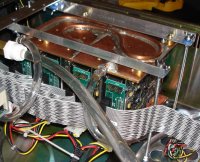
This cost put me a bit above what I thought was reasonable
for cooling my 4-disk SCSI raid-5 array. Half-height(1.62") disks,
they require substantial mounting hardware and dissipate about 11W
each. As usual, I forged ahead with a custom solution. After empirical
testing to be sure that the drives would in fact conduct a significant
amount of heat to a copper plate secured to their sides(using hot
water), I constructed a copper drive cage/water cooler for them. 1/4"
copper tubing, often used for ice makers, was bent and soldered to two
copper plates, one for each side. I obtained the 1/8" copper plate for
about $30 from McMaster
Carr. See the Hard
Drive Photos for construction details.
Power Supply (New 2/8/2005)
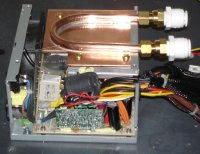
Of some concern are components in the supply which are not directly attached to the main heatsinks and would ordinarily depend upon some amount of airflow for proper cooling. With no fan at all, improper cooling of these components would result in elevated ambient temperatures within the power supply case. I have monitored this with my 1-wire sensors. Without the absolute loss of air exchange in the rackmount case, ambient temperatures have increased throughout, typically remaining from 90-110F, with the highest inside the power supply. Of course, the temperature of all water-cooled components has remained static. Informal spot checks indicate that no components are in excess of normal temperatures. Additionally, ambient temperatures respond within minutes to increase or reduction in water flow, suggesting good heat transfer from those components responsible for the elevated ambient temperature. (When I get a chance, I'll post more formal test results.)
Measuring Flow (Updated 1/5/2006)
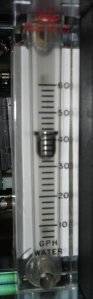
The rackmount machine has a Dwyer Visi-Float VFB 5-60GPM flowmeter. It has 1/8" NPTM connections on back, to which I attached the incoming water lines from the hard drives and the outgoing line to the power supply and motherboard coolers. See the Rackmount Photos for details. eBay often has new flowmeters at very reasonable prices. Find out as much about liquid compatablity as possible before purchasing.
Unresolved Issues
Electrolysis
From the beginning, I knew I had the potential to create a battery with dissovled ions in the water. I had no idea that I could achieve upwards of 0.25V between a copper pipe in the reservoir and the radiator. Given that both are copper, I'm still puzzled about why there is any potential whatsoever. I don't believe the pump is leaking current, since the voltages persist even when the reservoir is tied to ground. In addition, higher concentrations of antifreeze seemed to increase the observed potentials. Since the system is grounded at all possible points(both computers, tower, and reservoir), and since I've seen no real corrosion, I am merely puzzled, not concerned. I'd of course like to be able to explain it. See the Coolant Compatibility and Electrolysis section for more details.
Last Modified: 17 Nov 2009